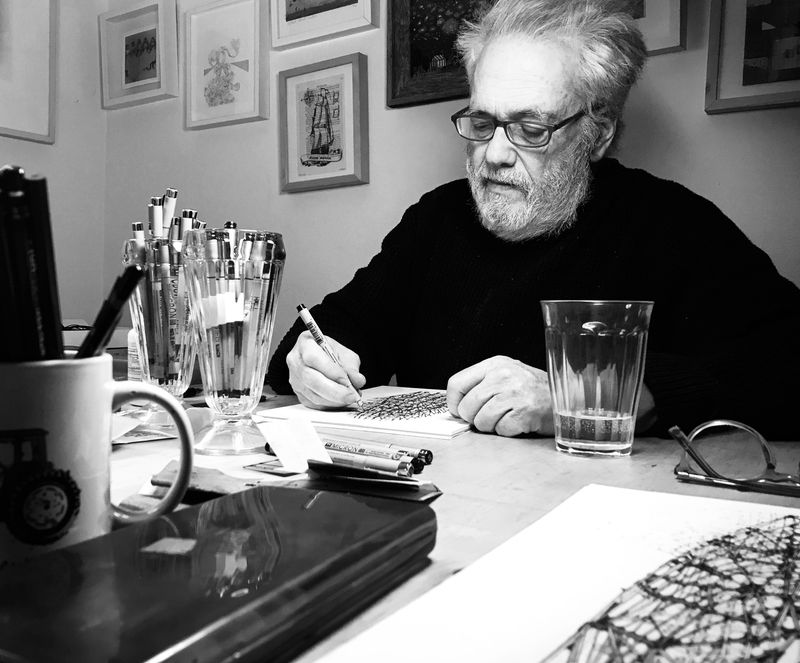
Stephen Talasnik has always been exploring the intersection of drawing and building. His ongoing investigation explores the near seamless connection of drawing, sculpture, ephemeral site specific, stage set, architecture, engineering, and product design.
His work is informed by time travel and “fictional function," intrigued with the infrastructure of the urban environment. The work is otherworldly, suggesting a moment in time without providing absolute coordinates.
Talasnik's ideas encapsulate the imagination of Jules Verne, the cinematography of Fritz Lang, the inventions of Nikolai Tesla and the architecture of Frederick Keisler. Whether drawn or built, variable repetition in engineering is driven by the use of space frames for construction. No measurement or software is used. The works organically evolve with a reliance on intuition; there is no desire to finish, rather an ambition to “complete.”
Originally from Philadelphia, he is a graduate of the Rhode Island School of Design and the Tyler School of Art. As a student at RISD, he came in contact with two instructors who would encourage his ongoing studio investigation of drawing; photographers Harry Callahan and Aaron Siskind. After completing his graduate study at Tyler — Rome and Philadelphia — he would eventually spend 15 years commuting between NYC and SouthEast Asia. It was there that a fascination with hand building re-emerged studying the art of bamboo construction. Having committed his studio activities to drawing since departing Graduate school, he executed his first piece of sculpture some 15 years later.
In addition to major installations at the Storm King Art Center, he executed site specific installations at the Denver Botanic Gardens and Manitoga, the Russel Wright House in Garrison NY. In addition to a permanent all timber frame structure at the Tippet Rise Art Center in Montana, he has built temporary indoor sets for performance at Tippet Rise, Architektur Galerie Berlin, and will create floating structures for the next Curitiba Biennale at the Oscar Niemeyer Museum in Brazil. His drawings are in the permanent collection of the Metropolitan Museum of Art (NY); The Albertina, (Vienna); the Pompedeu (Paris); National Gallery of Art (Washington DC); and the Kupferstichkabinett (Berlin) to name a few.
He continues to build and draw in NYC.